





Eggs and Dairy in Sailor's Accounts Menu: 1 2 3 4 5 Next>>
Animal Products in Sailor Accounts During the GAoP, Page 5
Called by Sailors: Butter
Appearance: 34 Times, in 19 Unique Ship Journeys from 23 Sailor Accounts.1
Locations Found in Sailor's Accounts: Kinsale, Ireland; Amsterdam & Rotterdam, Netherlands; Ghent, Belgium; Spitsbergen, Norway; Calais, France; Isla Maria Madre, Almayate, Spain; Ascension Island; Cape of Good Hope, Africa; Nicobar Islands; Ambon Island, Jakarta, Pulau Buton & West Java, Indonesia; Wari, West Papau; Northern Marianas; Haiphong, Vietnam; Guanzhou, Hong Kong; Guam; Jamaica; Cabo San Antonio & Isla de Juventud, Cuba; Caribbean; Mexico; Roaton, Honduras; Panama; Tierra del Fuego, South America; La Blanquilla & La Tortuga, Venezuela; Isla Lobos de Terra, Peru; Isla de la Plata, Ecuador
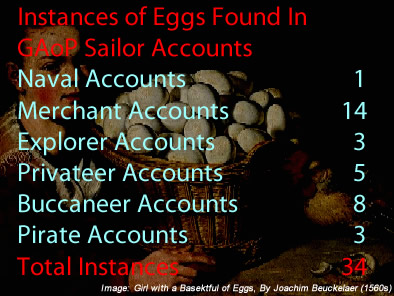
There are quite a number of instances of eggs being consumed by sailors during the Golden Age of Piracy. In fact, there are more instances than there were instances of cheese and butter which were standard issue to the English navy as well as on merchant sailors. Yet eggs could only be gotten on a long voyage while at sea if there were birds aboard to lay them because they would not last for long periods. Eggs from birds kept on board were mostly a luxury, however, typically reserved for the officers of a ship. None of the accounts under study suggest that hen's eggs were obtained in this way, including the account of a navy ship's chaplain Henry Teonge, who often provides great detail about the officers' food on the 3rd and 4th rate naval vessels in which he sailed. They would be more likely to be found in the officer's accounts from naval ships of higher rating.
So where did the eggs mentioned in the sailor's accounts come from? In nearly every case, they were obtained when the ship made landfall. (Turtle eggs were the exception here.) Sometimes they appear to have been consumed on land,
other times they were brought aboard. One account mentions purchasing 300 hen's eggs for a small fleet, while another brags of taking 10,000 penguin eggs during a journey.2 Several accounts mention the large number of turtle eggs.3
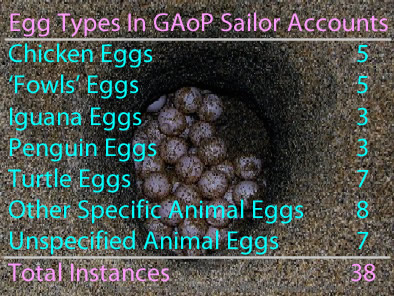
The variety of animal eggs which were eaten suggests in some way how desirable many sailors must have found them. Fresh food would naturally have been appealing to long-distance sailors after a steady diet of salt meats, boiled dry foods, hard bread and cheese and slightly rancid butter. While the type of animals whose eggs sailors sampled is pretty varied, only a few are mentioned more than once or twice. These include eggs from chickens and 'fowls', iguanas, penguins and turtles. The table seen at right indicates the number of instances of each type of animal eggs along with a category for animals whose eggs do not appear three times or more and one for nonspecific animal eggs.
Note that it is likely that the eggs which are linked to 'fowls' are, in fact, chicken eggs. It is also probable that many, if not all, of the unspecified animal eggs are also from chickens. However, in the interest of providing accurate information, these categories are listed separately in the chart. Each of these animal eggs are discussed in their own section. The 'fowl' and unspecified eggs will be discussed in the chicken egg section.
For ease of reference, the egg and specific dairy productscan be directly accessed in the list below. Clicking on the name will take you directly to the relevant page.
Animal Eggs Found in Sailors' Accounts During the Golden Age of Piracy |
||||
|---|---|---|---|---|
| Chicken | Iguana | Penguin | Turtle | Other Animals |
1 Philip Ashton, Ashton's Memorial, 1726, p. 49; Edward Barlow, Barlow's Journal of his Life at Sea in King's Ships, East and West Indiamen & Other Merchantman From 1659 to 1703, 1934, p. 201 & 550; Thomas Bowrey, The Papers of Thomas Bowrey, 1669-1713, 1927, p. 75, 77, 78 & 80; Edward Cooke, A Voyage to the South Sea and Round the World, V1, 1712, p. 325; Edward Cooke, A Voyage to the South Sea and Round the World, V2, 1712, p. 9 & 56; William Dampier, A New Voyage Round the World, 1699, p. 14, 57, 97, 104, 159, 455 & 533; William Dampier, "Part 1", A Supplement to the Voyage Round the World, 1700, p. 25; William Dampier, "Part 2", A Supplement to the Voyage Round the World, 1700, p. 75; William Dampier, A Continuation of a New Voyage Round the World, Vol III, 1709, p. 93 & 180; Johann Dietz, Master Johann Dietz, Surgeon in the Army of the Great Elector and Barber to the Royal Court, 1923, p. 132; William Funnell, A Voyage Round the World, 1969, p. 226 & 266; Alexander Hamilton, A New Account of the East Indies, 1746, p. 491; Daniel Defoe (Capt. Charles Johnson), A General History of the Pyrates, Manuel Schonhorn, ed., 1999, p. 291 & 466; Francis Rogers, "The Diary of Francis Rogers", Three Sea Journals of Stuart Times, 1936, p. 195 & 230; Henry Teonge, The Diary of Henry Teonge, 1825, p. 268; Nathaniel Uring, The Voyages and Travels of Captain Nathaniel Uring, 1928, p. 161 & 242; John Wood, Captain Wood's Voyage Through the Streights of Magellan, &c., from William Hacke's A collection of original voyages, p. 62; 2 Cooke, Voume 2, p. 9 & Wood, p. 62; 3 Cooke, Vol. 1, p. 325 & 328, Defoe (Johnson), p. 291-2 & Rogers, p. 230;
The Medicinal Value of Eggs
The value of eggs in medical literature during this period does not differentiate between what type of animal produced them for the most part. With this in mind, the discussion of their value to medicine is examined here rather than in the detailed discussions which follow. Much of the medical literature from this time is derived from ancient physicians such as Galen and Paracelsus and they were usually writing about fowl's eggs.
Eggs and Dairy in Sailor's Accounts Menu: 1 2 3 4 5 Next>>

Main Page • Tools & Procedures • Miscellanea • About the Author • Facebook Page
All original content copyright M. Kehoe • 2003-