



Eggs and Dairy in Sailor's Accounts Menu: 1 2 3 4 5 Next>>
Eggs and Dairy in Sailor Accounts During the GAoP, Page 1
Dairy was an important part of the sailors diets, particularly butter and cheese. This is because both are found in the standard English naval diet for ships at sea for long periods during the golden age of piracy. According to the 1677
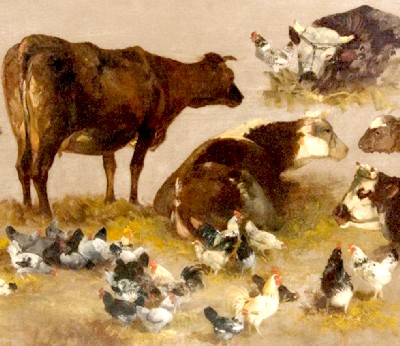
Image Artist: Alexandre Defaux
Study of Cows and Chickens (19th Century)
contract for the English navy, butter was served as a 'sawce' along with cheese three days a week.1 Both remained a part of the naval menu throughout the golden age of piracy. Eggs and milk were not part of the English naval diet, almost certainly because they wouldn't keep for longer periods like butter and cheese could. However, they do appear with some frequency in the sailors diets of this period as we shall see.
Proteins, found in eggs, butter, milk and cheese, are an important source of amino acids which are used to repair the body as well as provide a source of energy. While the contribution of amino acids wasn't recognized at this time, the importance of cheese was. Contemporary physician Clifton Wintringham explained. "The Substances taken from the Animal Kingdom, are undoubtedly best qualified to repair the Losses our Bodies daily sustain, both in their Solids and Fluids"2. Wintringham's focus was primarily on meat, however it could apply to cheese. Unfortunately, butter doesn't actually offer as much in the way of protein as the other two dairy products. However, when made from the milk of grass fed cows is recognized today as a good and balanced source of vitamins A and K2, beta carotine and omega-3 fatty acids.3
Let's look at these four items in greater detail.
1 J. R. Tanner, A Descriptive Catalogue of the Naval Manuscripts in the Pepsyian Library, 1903, p. 166; 2 Clifton Wintringham, A Treatise of Endemic Diseases, 1718, p. 114; 3 Makayla Meixner, "7 Reasons to Switch to Grass-Fed Butter", Healthline.com, Gathered 8/14/24
Egg and Dairy Foods Found In Sailors' Accounts
There are
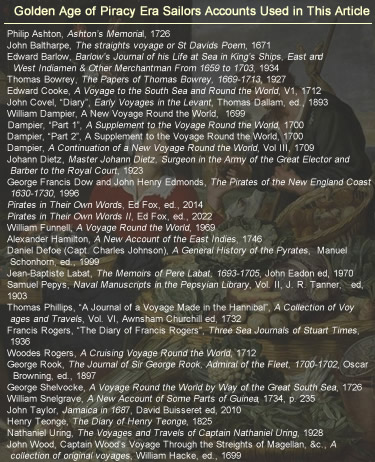
Image Artist: Pietro da Cortona - Landscape with Harvesting (1750)
three different types of dairy products found in the sailors accounts during the golden age of piracy: milk, butter and cheese. Eggs are a category unto themselves, although they are further subdivided by animal type when there is more than instance found in the accounts. There are a few examples of dairy products produced from the milk of animals other than cows, but they are few enough not to be worth identifying seperately in the numbers the way eggs are; these will instead be highlighted in the text attached to each category. A full listing of the texts which mention the use of eggs and dairy foods by sailors can be found at left.
An overview of the instances of eggs and dairy categories can be seen in the chart below. The instances of milk is much lower than instances of butter and cheese. This is likely because of the use of butter and cheese by the English navy, which would lead to them being viewed as a staple food for sailors while at sea. Many English sailors had either enlisted or been forced into naval service during this period so they might expect a similar diet on other ship types. Of course, a big part of the reason the navy chose these foods was because of their ability to keep for longer periods than foods like milk during months long ocean voyages.
The total number of egg instances is higher than any of the dairy instances. While officers sometimes kept chicken coops shipboard to provide them with fresh eggs and meat, none of the instances counted are from shipboard coop kept chickens. Most of them come from sailors on land or those which were brought aboard after making landfall.
Each entry for eggs and dairy which follow will have the same layout. It will first give the name of the food. It then lists any alternate names(s) or spellings found in the sailor's accounts,
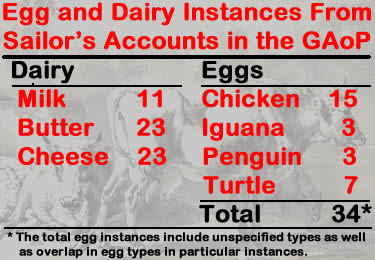
Image Artist: Adriaen van de Velde (mid-17th century)
Egg and Dairy Instances From Sailor's Accounts in the Golden Age of Piracy
the number of times that food appears in the sailor accounts under study, the number of different accounts containing it and the number of different ships journeys in which it appears (some authors accounts present journeys on a several ships, so there can be overlap.) A chart is also included showing which types of sailor's accounts mention the egg or dairy food.
The main body of each entry includes a period description of the food, providing any details given about the taste and preparation in books from that time. Note that most of the sailor's books fail to provide detail about its flavor or use of any of the foods listed. In such cases, information is taken from other sources. The emphasis in this article is on the period descriptions and understanding of animal-based meats and non-meat foods. In the rare instances where period descriptions are lacking or incomplete, modern descriptions are used.
Artist: Albert Anker
Hippocrates Composite Portrait
Paracelsus Aureolus Theophrastus Bombastus
von Hohenheim (1455)
Since this website concerns medicine, some information on humoral properties originally suggested in the works of Hippocrates. He identified four humoral properties present in nearly everything including foods. This was expanded upon by some of his later followers, particularly Galen of Pergamon The four properties associated with food include hot, cold, moist and dry. According to the primary medical theory in use during this period, the humoral properties of food combined with a patient's own humoral makeup (affecting the body's humoral fluids blood, phlegm, yellow and black bile) impacting the patient's health.
One botanical author regularly used in this article - Louis Lémery - relies upon the three Paracelsian principles instead of humors. These principles include salt, which composes the solid state of a body; sulfur, responsible for an inflammable or fatty state; and mercury, engendering a smoky (vaporous) or fluid state.3 The translation of Lémery's work uses the terms salt, oil and phlegm, with phlegm apparently corresponding to mercury.
Finally, specific comments of interest about the medicinal or healing properties of eggs and dairy products are provided. These sometimes tie directly into the humoral theory, although it is more often an indirect relationship. However, sea surgeons would typically be less interested in such esoteric, theoretical connections to humor theory than physicians; surgeons were more focused an animal product's direct impact on the patient's health.
For ease of reference, the egg and specific dairy productscan be directly accessed in the list below. Clicking on the name will take you directly to the relevant page.
Dairy Products and Eggs Found in Sailors' Accounts During the Golden Age of Piracy |
|||
|---|---|---|---|
| Milk | Butter | Cheese | Eggs |
Eggs and Dairy in Sailor's Accounts Menu: 1 2 3 4 5 Next>>

Main Page • Tools & Procedures • Miscellanea • About the Author • Facebook Page
All original content copyright M. Kehoe • 2003-