





Cereal Grains in Sailors Accounts Menu: 1 2 3 4 Next>>
Animal Products in Sailor Accounts During the GAoP, Page 1
Animal products (excluding seafood which is discussed in another article) were an important part of most sailors diets. This is underscored by the sheer number of mentions of these foods in sailor's accounts, which exceeds the number of mentions found in every non-animal food category. Examples of the standard meats - beef, pork, fowl and non-beef ruminants (goats, sheep, deer, etc.) - are found in every type of sailor account. Even some of the more exotic meats are found in the most of the sailor account types. The diet of the buccaneers is notably built around meat - the word buccaneer is derived from the French word for barbecue: 'boucan'.
Proteins, found in meat, eggs, milk and cheese, are an important source of amino acids which are used to repair the body as well as provide a source of energy. Although the contribution of amino acids wasn't recognized at this time, the importance of animal proteins was. Contemporary physician Clifton Wintringham explained. , Georg Emanuel Opiz, 1804.jpg)
Artist: Georg Emanuel Opiz - Der Völler [The Glutton] (1804)
"The Substances taken from the Animal Kingdom, are undoubtedly best qualified to repair the Losses our Bodies daily sustain, both in their Solids and Fluids"1. He goes on to make the fascinating argument that, in eating the meat of animals, we are taking advantage of their having already processed the 'Vegetable Matter' they had eaten [apparently referring to all plant produced foods], which otherwise "must be done by the Action of our own Bowels and Juices, and consequently the Animal, must be much more nourishing, than the Vegetable Food."2
Three non-seafood sources of protein are found in the standard English naval diet for ships at sea for long periods during the golden age of piracy: salt beef, salt pork, and cheese. In addition, another element of the standard navy diet discussed in this article is butter. Although it doesn't offer much in the way of protein, it is made from animal milk/cream, so is included here. According to the 1677 contract for the navy, some form of non-fish meat was served to sailors four days a week, with fish and butter serving as 'sawce' along with cheese were normally served on the other three days.3 In 1691, an order was given that oatmeal could replace fish, although the butter and cheese remained on the menu.4 By 1701, "Three pounds of flour, and either a pound of raisins or half a pound of currants or half a pound of pickled beef-suet, in lieu of a piece of beef or pork and peas" for ships sailing south of the 39° N parallel.5 In addition, the admiralty notified the navy that fresh meat to be provided to ships waiting in port in lieu of salt meat, "considering it not only generally good for the men's health, but also a powerful preventive against scurvy."6
Considering the ubiquotiousness of meat and other animal products found in the accounts of the various sailor types and the English navy's careful, repeated attention to it, there can be no doubt that meat was considered an essential element in the sailors diet.
1,2 Clifton Wintringham, A Treatise of Endemic Diseases, 1718, p. 114; 3 J. R. Tanner, A Descriptive Catalogue of the Naval Manuscripts in the Pepsyian Library, 1903, p. 166; 4 R.D. Merriman, The Sergison Papers, (Naval Clerk of Acts), 1950, p. 236; 5 Merriman, Queen Anne's Navy, 1961, p. 255; 6 Daniel A Baugh, Naval Administration 1715-1750, 1977, p. 405 & Merriman, Queen Anne's Navy, p. 268
Meat and Animal-Based Foods Found In Sailors' Accounts
The number
Image Artist: Pietro da Cortona - Landscape with Harvesting (1750)
of broad meat and other animal-based foods found in the period sailors accounts is 101. (A full listing of the authors which mention the use of animal-based foods can be found at left.) While some accounts only mention animal-based foods using such broad categories, others get into more specifics, mentioning the particular type of animal meat or egg they were eating. In addition, there are a couple different dairy products identified included butter, milk and cheese. Where such specifics are mentioned by more than one author, information will be provided about each animal or protein type within the larger category.
The main protein categories can be found in the chart below. Broadly speaking, the proteins consumed by sailors are divided into two groups. The first are the very popular proteins which appear 75 times or more in the sailors accounts and the second are those which appear less 23 times or less. This suggests in part the popularity of certain meats - iguana, monkey and other meats were clearly not preferable and in part to the availability of other proteins such as rabbits, dairy products and eggs. Dairy and eggs in particular would not keep for long on a ocean voyage which often lasted months.
It is likely that (as with other foods), the English navy's standard diet created a template of foods appropriate at sea. Many English sailors had either enlisted or been forced into naval service during this period and, to some degree, might expect a similar diet on other ships. This would account for the popularity of beef and pork, although it doesn't indicate why dairy products, specifically cheese and butter, weren't more popular. Yet the most popular meat - fowl - isn't a part of the standard naval diet and the ruminants category, which contains goats, sheep and deer among others, is nearly as popular as beef. So while there was a definite preference for meat among sailors, it wasn't necessarily restricted to those meats the navy supplied. (This may have had something to do with the difference between fresh meat and the salted beef and pork the navy supplied at sea.)
As mentioned, within most of the broad categories, some specific animals are called out. Each entry for individual meat products mentioned in this article first gives the regular name for the animal followed by the genus and species in parenthesis. It then lists any alternate names(s) given in the sailor's accounts,
, Francesco Bassano the Younger, late 16th or early 17th.jpg)
Image Artist: Francesco Bassano the Younger,
Butchers, Diciembre [Capricornio] (late 16th or early 17th Century)
the number of times that animal product appears in the sailor accounts under study, the number of different accounts containing it and the number of different ship's journeys in which it appears (some authors accounts present journeys on a several ships, so there can be overlap.) A chart is also included showing which types of sailor's accounts mention the animal-based food.
The main body of the text includes a period description of the food, providing any details given about the taste and preparation in books from that time. Note that many of the sailor's books simply mention the name of the animal found without providing much detail about its flavor or use. In such cases, information is taken from other sources. The emphasis in this article is on the period descriptions and understanding of animal-based meats and non-meat foods. In the rare instances where period descriptions are lacking or incomplete, modern descriptions are used.
Artist: Albert Anker
Hippocrates Composite Portrait

Paracelsus Aureolus Theophrastus Bombastus
von Hohenheim (1455)
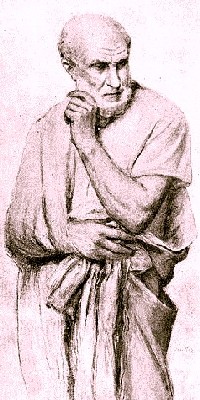
Since this website concerns medicine, some information on humoral properties originally suggested in the works of Hippocrates. He identified four humoral properties present in nearly everything including foods. This was expanded upon by some of his later followers, particularly Galen of Pergamon The four properties associated with food include hot, cold, moist and dry. According to the primary medical theory in use during this period, the humoral properties of food combined with a patient's own humoral makeup (affecting the body's humoral fluids blood, phlegm, yellow and black bile) impacting the patient's health.
One botanical author regularly used in this article - Louis Lémery - relies upon the three Paracelsian principles instead of humors. These principles include salt, which composes the solid state of a body; sulfur, responsible for an inflammable or fatty state; and mercury, engendering a smoky (vaporous) or fluid state.3 The translation of Lémery's work uses the terms salt, oil and phlegm, with phlegm apparently corresponding to mercury.
Artist: Frans Snyders -
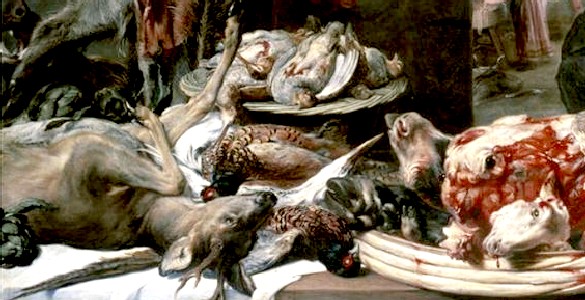
Various Animal Food Products, Detail From The Butcher (17th c.)
Finally, specific comments of interest about the medicinal or healing properties of animal products are provided. These sometimes tie directly into the humoral theory, although it is more often an indirect relationship. However, sea surgeons would typically be less interested in such esoteric, theoretical connections to humor theory than physicians; surgeons were more focused an animal product's direct impact on the patient's health.
For ease of reference, the specific meat and non-meat animal foods can be directly accessed in the list below. Clicking on the name will take you directly to the general category. If there are subcategories, they will be listed there with similar links which will allow you to jump to the individual entry.
Non-Meat Animal Products Found in Sailors' Accounts During the Golden Age of Piracy |
|||
|---|---|---|---|
| Dairy | Eggs | Non-Fish Meats Found in Sailors' Accounts During the Golden Age of Piracy |
|
| Beef | Fowl | Iguana | Monkey |
| Pork | Rabbits | Ruminants | Other |
1 "The Arraignment, Tryal and Condemnation of Capt. John Quelch", A Complete Collection of State Trials, Vol. 14, 1700-1708, 1825, p. 1082; John Atkins, A Voyage to Guinea and Brazil, 1735, p. 59, 62 & 152; John Baltharpe, The straights voyage or St Davids Poem, 1671, p. 54; Edward Barlow, Barlow's Journal of his Life at Sea in King's Ships, East and West Indiamen & Other Merchantman From 1659 to 1703, p. 74, 83, 228, 312, 361 & 372; Thomas Bowrey, The Papers of Thomas Bowrey, 1669-1713, 1927, p. 194-5; Edward Cooke, A Voyage to the South Sea and Round the World, V2, 1712, p. 9, 15, 43 & 68; John Covel, Diary, Early Voyages in the Levant, Thomas Dallam, ed., 1893, p. 120; William Dampier, A New Voyage Round the World, 1699, p. 78, 303 & 474; William Dampier, "Part 1", A Supplement to the Voyage Round the World, 1700, p. 22 & 126;William Dampier, "Part 2", A Supplement to the Voyage Round the World, 1700, p. 128; William Dampier, A New Voyage Round the World, Vol III, 1703, p. 150 & 163; Jonathan Dickenson, God's Protecting Providence, 1700, p. 49; Johann Dietz, Master Johann Dietz, Surgeon in the Army of the Great Elector and Barber to the Royal Court, 1923, p. 128; George Francis Dow and John Henry Edmonds, The Pirates of the New England Coast 1630-1730, 1996, p. 63; Clement Downing, A Compendious History of the Indian Wars, 1737, p. 24; Pirates in Their Own Words, Ed Fox, ed., 2014, p. 35, 101, 245 & 284; Amedee-Francois Frezier, Voyage to the South Seas, 1717, p. 316; William Funnell, A Voyage Round the World, 1969, p. 93 & 150; Alexander Hamilton, A New Account of the East Indies, 1746, p. 52, 68, 144, 280, 353 & 439; John Franklin Jameson, Privateering and Piracy in the Colonial Period – Illustrative Documents, 1923, p. 182, 183 & 184; Daniel Defoe (Capt. Charles Johnson), A General History of the Pyrates, Manuel Schonhorn, ed., 1999, p. 57, 98, 130, 183, 188, 215 & 446; Jean-Baptiste Labat, The Memoirs of Pere Labat, 1693-1705, John Eadon ed, 1970, p. 197; Ravaneau de Lussan, The History of the Buccaneers of America, 1856, p. 336, 415 & 460; Pyrates Lately taken by Captain OGLE", 1723, p. 70; Basil Ringrose, The Adventures of Capt. Barth. Sharp, And Others, in the South Sea, 1684, p. 20 & 41; Woodes Rogers, A Cruising Voyage Round the World, 1712, p. 26; Bartholomew Sharp, "Captain Sharp's Journal of His Expedition", A Collection of Original Voyages, William Hacke, 1699, p. 43; George Shelvocke, A Voyage Round the World by Way of the Great South Sea, 1726, p. 94, 100, 189, 268, 300 & 426; The Tryals of Major Stede Bonnet, 1719, p. 19; 2 "The Arraignment, Tryal and Condemnation of Capt. John Quelch", A Complete Collection of State Trials, Vol. 14, 1700-1708, 1825, p. 1082; John Baltharpe, The straights voyage or St Davids Poem, 1671, p. 14 & 73; Edward Barlow, Barlow's Journal of his Life at Sea in King's Ships, East and West Indiamen & Other Merchantman From 1659 to 1703, p. 270; Thomas Bowrey, The Papers of Thomas Bowrey, 1669-1713, 1927, p. 194-5; Edward Cooke, A Voyage to the South Sea and Round the World, V1, 1712, p. 60 & 324; John Covel, Diary, Early Voyages in the Levant, Thomas Dallam, ed., 1893, p. 115; Ambrose Cowley, A Collection of original voyage, William Hack, Ed., 1699; CSPC America and West Indies, vol. 12, Item 1406; Daily Courant, 8-8-22, Issue 6489; William Dampier, "Part 2", A Supplement to the Voyage Round the World, 1700, p. 18 & 38; Jonathan Dickenson, God's Protecting Providence, 1700, p. 49; Johann Dietz, Master Johann Dietz, Surgeon in the Army of the Great Elector and Barber to the Royal Court, 1923, p. 128; George Francis Dow and John Henry Edmonds, The Pirates of the New England Coast 1630-1730, 1996, p. 60; Clement Downing, A Compendious History of the Indian Wars, 1737, p. 97; Peter Earle, Sailors English Merchant Seamen 1650-1775, 1998, p. 88 & 89; Pirates in Their Own Words, Ed Fox, ed., 2014, p. 23, 25, 99, 106, 177 & 255; Amedee-Francois Frezier, Voyage to the South Seas, 1717, p. 75; William Funnell, A Voyage Round the World, 1969, p. 93 & 247; The Indian Antiquary, George Hill, ed., November, 1919, p. 205; The Indian Antiquary, George Hill, ed., January, 1920, p. 3; John Franklin Jameson, Privateering and Piracy in the Colonial Period – Illustrative Documents, 1923, p. 294; Daniel Defoe (Capt. Charles Johnson), A General History of the Pyrates, Manuel Schonhorn, ed., 1999, p. 98 & 297; Ravaneau de Lussan, The History of the Buccaneers of America, 1856, p. 402; Stephen Martin-Leake, The Life of Sir John Leake, 1920, p. 222; Pyrates Lately taken by Captain OGLE", 1723, p. iv; Basil Ringrose, The Adventures of Capt. Barth. Sharp, And Others, in the South Sea, 1684, p. 26; Jeremy Roch, "The Diaries of Jeremy Roch", Three Sea Journals of Stuart Times, Bruce Ingram, ed., 1936, p. 127; George Shelvocke, A Voyage Round the World by Way of the Great South Sea, 1726, p. 100, 189, 371 & 426; Henry Teonge, The Diary of Henry Teonge, 1825, p. 144 & 200; Silas Told, An Account of the Life, and Dealings of God with Silas Told &c., 1786, p. 14-5; 3 "From Alchemy to Chemistry: Five Hundred Years of Rare and Interesting Books", illinois.edu website, gathered 7/28/22;
General Comments on Meat and Dairy Products
Before delving into the details of the individual types of animal meat and other products, let's look at some general comments about them. During the period, physicians felt that diet was nearly inextricable from the health, resulting in much commentary on the topic. French physician Louis Lémery began his discussion on

Artist: Frans Snyders - Various Meats, Detail From The Butcher (17th c.)
"Foods prepared of Animals" by dividing them into four 'Classes': Terrestrial, Flying or Fowls, Aquatic and Amphibious.
We may say in general that Terrestrial Animals nourish more than all the rest, and afford a more solid and subitantial Food, that does not waste as soon as that of other Animals. As for Fowls, they are for the most part more agreeable and delicious than Terrestrial Animals, and also easier of Digestion. Lastly, Fish of all other are most easily digested, most moist and cold, but they are not so nourishing, and more liable to corrupt than the rest.1
Fish, although animal meat, are not discussed here; being such an important and readily available part of the sailor's diet, they are examined in another article focusing on all the different types of seafood mentioned in the period sailors accounts.
With regard to meat, Lémery follows the ancient physician Galen by discussing two different types:
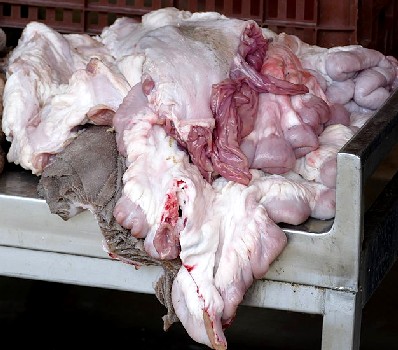
Photo: Wiki User Kritzolina
Sheep Offal (Organ Meat) at a Market in Bizerte, Tunisia
the flesh and the organs. He begins with "Musculous Flesh, which is of all other [types of flesh] the most nourishing, that which
produces the best Juice, and that lastly which is most in use: It makes up the greatest part of the Animal."2 He next lists various internal organs of animals, dealing with each. Those he discusses include the liver, spleen, kidneys, heart, lungs, glands, testicles, tongue, brains, stomach, intestines and bones (referring to bone marrow). (Every part of an animal was considered food at this time. Joan Thirsk documents the English fascination with sheep and calf heads as food between 1500 and 1760.3) Lémery considers several organ meats to be 'hard of digestion' including the liver, spleen, kidneys, brain, stomach, intestines and heart. Others he advised were 'light' and easy to digest such as the lungs, glands, testicles and tongue. He recommended the heart as "good Nourishment", the lungs as "soft, moist, juicy, and light... [and] Nourishing", the glands and bone marrow as nourishing and the tongue as "excelling all the rest, for the excellency of it's Taste". He suggested discernment when eating liver, kidneys and testicles, generally advising to eat only those of young animals or, in the case of liver, when an animal has been fed "good Aliments... in great
plenty". The rest of the organs he did not find to be good food for the most part.4
Physician William Salmon indicates the humoral qualities of animal organs as food. Among them, he explains that brain tissue as food "is soft, moist [and] flegmatick [humoral properties]", the spleen "destroys Melancholy [humors]", the stomach and intestines "are cold, hard, dry and glutinous... [and] generate [the humor] Flegm", bone marrow "is hot and moist, and, if well concocted

Photo: William Sherwin - Physician William Salmon (1671)
[converted or what we might call digested]... it moistens and loosens the Bowels". His other comments generally agree with Lémery regarding digestibility of and nourishment provided by various organ meats. He does advise that animal fat "is thought not to nourish much; yet it contributes much to nourishment, by reason it softens and loosens the Bowels, opens Obstructions, makes the Passages [intestines, presumably] slippery, and apt to receive the mutriment, whereby it may the more easily be conveyed over the whole Body."5
Salmon makes other comments on 'Meats from animals', advising that the flesh of young animals "is more moist, soft, excrementitious [able to be excreted or removed from the body], and easie of Digestion, than the Flesh of those which are elder... [which is] dryer, harder, less nutritive, and more difficult of Concoction [conversion into products usable by the body.]" He also notes that "The Flesh of Wild Creatures is dryer, and less Excrementitious than those of the Tame: And the flesh that is lean and extenuated [leaner or lesser], is dry and hard of Digestion, yielding but little Nourishment, whilest that which is fat and full of Juice, is easie to be concocted, and nourishes much."6 He suggests that animals which feed 'in good Pasture, or on good Food' are more sweet and nourishing. The flesh of castrated (gelt) animals and birds "is more tender, sweet and easies of digestion... as is evident in Oxen, Wethers [castrated rams], Hogs, Capons [castrated chickens], &c."7
Physician George Cheyne, whose medical opinion is deviated from both Paracelsian and Galenist perspectives offers some
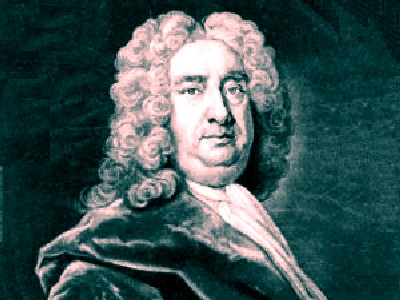
Photo: Johan van Diest -
Physician George Cheyne (1732)
interesting views on animal meat. He warns that "Adult Animals abound more in urinous Salts than young ones: Their Parts are more closely compacted, because more forcibly united; and so harder of Digestion."8 Cheyne believed that the body's ability to break food down into it's 'constitutant Particles'. Where they couldn't be effectively 'concocted' (processed), the circulation slowed and the resulting nutritive juices contained so much salt they became corrosive and ruined the food's usefulness to the body. From this, he proposed a number of ideas, including "those Vegetables and Animals, that come to Maturity the soonest, are lightest of Digestion", " the larger and bigger the Vegetable or Animal is... the stronger and the harder to digest is the Food made", the flesh of animals which ate plants was easier to digest than those which ate meat, animals with lighter-colored flesh 'were lesser in bulk' and thus easier to digest than those with darker (red and brown) colors, "and Animals of a strong, poignant, aromatick and hot Taste, are harder to digest than those of a milder, softer, and more insipid Taste. High Relish comes from abundance of Salts"9. He also warned against meat from "cramm'd Poultry, or stall-fed Butchery"10. 'Cramming' referred to force-feeding captive animals with foods designed to fatten them shortly before slaughter.
In a less theoretical vein, Lémery notes that the food an animal eats directly impacts the quality of their flesh.
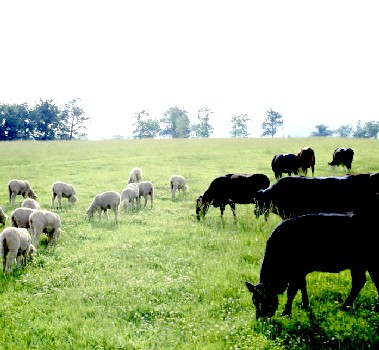
Photo: USDA - Cattle and Sheep Grazing
In a word, what difference of taste is there between the Flesh of Rabbits fed in Houses, with Cabbige Leaves, &c. and those that live in Warrens, and feed upon strong and sweet-smelling Herbs. How does the Flesh of Domestick Hogs, that feed upon all kinds of nastiness, differ from that of the Wild Hog or Boar that Iives upon Acrons, and other Aliments they find in the Woods? It's said that those who live towards the Northern Ocean [in France], having no Grass in their Country, feed their Oxen and Cows with Fish; and thus the Flesh of those Animals, as well as the Milk of the Cows., tasts altogether Fishy.11
Since the diet of an animal naturally affects the flavor of its' meat, this shouldn't be surprising, although it is interesting that such fine differences were mentioned. Modern historian Thirsk reports, "Commentators on meat differentiated the different types of fodder given to meat animals for its effect on meat flavour, and in the sixteenth and seventeenth centuries this was a particularly lively subject with regard to sheep meat because of changing farm practices."12
There is a perception that the English favored meat above all other foods in the seventeenth and eighteenth centuries, which has roots in literature. Of the 'plaine Country Fellow', English bishop John Earle wrote (rather tongue in cheek) in 1628 that

Photo: Peter Jacob Horemans -
People Dining (1745)
"he cares not grasse, because he loves not sallets. ...he is a terrible fastener on a piece of Beefe [for his dinner] & you may hope to stave the Guard off sooner.”13 Almost one hundred years later, French traveller César De Saussure commented, "English people are large eaters; they prefer meat to bread, some people scarcely touching the latter."14 During the golden age of piracy, physician George Cheyne wrote "The Meat [meaning 'food'] of England is generally animal Substances."15
However, modern historian Joan Thirsk explains, "extravagant accounts of English meat-eating gave a one-sided picture... Doubtless it was satisfying for the English to live on a legend ...[b]ut the actual quantities in daily consumption among ordinary folk were far more modest."16 She also points out the little was written about raising poultry in the 17th century because its "management was regarded as women's work, and the menfolk took little notice."17 (Men wrote most of the books at this time.) She adds, "Herbs and greenstuff were so abundant everywhere in fields, hedgerows and woods that they scarcely drew any comment from sixteenth-century writers, and it is only later in our period that we shall meet botanists explicitly describing the way countrywomen gathered them as family food."18 Even sailors ate them when the opportunity presented itself, as discussed in the article on vegetables. Nevertheless, the perception presisted and likely has at least some validity.
1,2 Louis Lémery, A treatise of foods in general, 1704, p. 137; 3 See Joan Thirsk, Food in Early Modern England, 2006, pp. xi, 46, 85, 144, 150, 185, 189, 204, 212 & 226; 4 Lémery, pp. 139-43; 5 William Salmon, Synopsis Medicinæ: A Compendium of Physick, Chirurgery, and Anatomy, 1695, p. 41; 6 Salmon, p. 38; 7 Salmon, p. 39; 8 George Cheyne, An Essay of Health and Long Life, 1724, p. 20; 9 Cheyne, pp. 22-6; 10 Cheyne, p. 28; 11 Lémery, p. 138; 12 Thirsk, p. 24; 13 John Earle, Micro-cosmographie, Or, A Peece of the World Discovered, 1628, p. 28, ii-iii; 14 César De Saussure, A Foreign View of England In The Reigns Of George I and George II, Madame Van Muyden, ed., 1902, p. 220; 15 Cheyne, p. 20; 16 Thirsk,p. 236; 17 Thirsk, p. 252; 18 Thirsk, p. 24
Cereal Grains in Sailors Accounts Menu: 1 2 3 4 Next>>

Main Page • Tools & Procedures • Miscellanea • About the Author • Facebook Page
All original content copyright M. Kehoe • 2003-