





Food By Sailor Type Menu: 1 2 3 4 5 6 7 8 9 10 11 12 13 14 15 16 17 18 Next>>
Sailors' Food Procedures During the Golden Age of Piracy, Page 1
"Without question, equipping and preserving sufficient food and drink on long-distance voyages was intimately tied with the survival of the crew in terms of morale and nutrition and, ultimately, could determine the success or failure of the voyage." (Cheryl A. Fury, "Health and Health Care at Sea", The Social History of English Seamen, 1485-1649, p. 198)
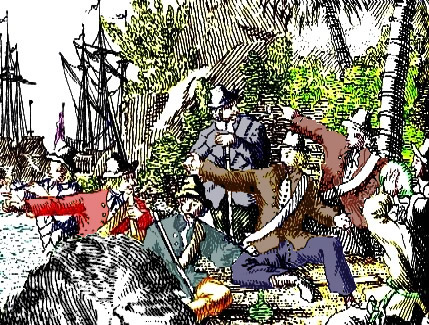
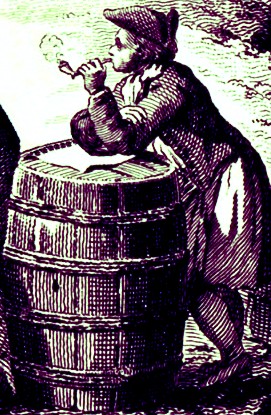
Pirate Edward Low's Men Dining, From
Historie der Engelsche Zee-Rovers (1725)
Food is a topic of monumental importance to all those who made voyages of any significant duration. It had a direct impact on the health and well-being of a crew and was considered a crucial part of those healing from wounds and surgeries during the golden age of piracy.
There is a wealth of information about some of the elements of feeding sailors during this period, particularly what they ate and how they got it. This information exists partially because the navy was involved with the kinds and procurement of food on long voyages and they kept fairly good records. In addition, as sailors expanded the map, they also expanded their diet with some of them taking notes on what they consumed. However, actual preparation and eating of food were apparently considered so mundane that seamen barely mention them in their accounts. Nor are period cookbooks necessarily a reliable guide to food preparation and consumption by sailors since they were written primarily for the upper classes in England. As nautical food researcher Grace Tsai notes, "Cookbooks were often made by and for the elite, because most people couldn’t even read and write.”1 There is some
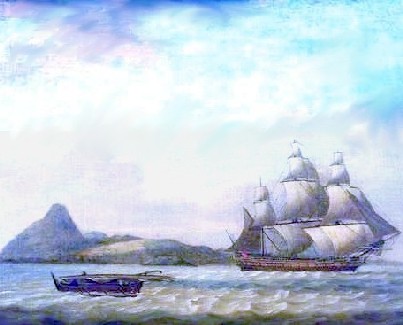
Artist: Thomas Luny - East Indiaman Hindostan, (1792)
educated discussion about how many sailors were able to read or write (the two skills were taught separately)2, but the recipes found in a cookbook belie their usefulness at sea, where fresh foods were rarely available on ships making long voyages.
This is the sixth of a series of articles which look at the food consumed by English sailors during the golden age of piracy (1690-1725), broadly dividing them by ship type: navy, merchant, privateer, select buccaneers, and pirate. The first article examines how food was used by the body and looked at the perception of healthiness of food provided to sailors. The second article discusses the many ways sailors obtained food while traveling. The third article is a continuation of ideas about obtaining food while under sail, focusing on several formal and informal 'provisioning stations' which were used by sailors. The fourth article examines how food was organized shipboard, looking at the navy's system (which impacted all other English vessels) and the various officers involved in getting, stowing, retreiving, accounting for and preparing food. The fifth article looks at how food was prepared and eaten shipboard. This article discusses the food found in the various sailor's accounts, giving and overview of foods eaten at sea and in port.
1 Tyler Allen, "Dining on the high seas", Spirit Magazine, Texas A&M Foundation Website, gathered 9/4/19; 2 See Ed Fox, Piratical Schemes and Contracts, Thesis, 2013, pp. 90-101
Sailors' Food Procedures During the Golden Age of Piracy
This article examines procedures governing food consumption on English vessels. It is broadly divided into two parts.The first concerns procedures found for each of the five types of long-voyage sailors under consideration. The second looks at procedures that affected every type of long-haul sailor during the golden age of piracy.
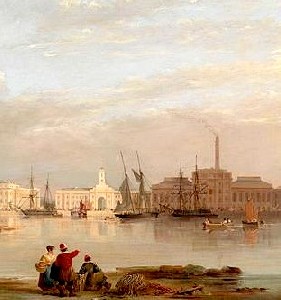
Artist: Nicholas Condy
The Victualling Office at Plymouth (1835)
Each of the five types of sailors under consideration here could have somewhat different diets. Where possible, this is divided by food provision at sea versus that provision in port, with the distinction between the two being clearest among naval and merchant sailors as we shall see. Not surprisingly, food in port for every type of sailor tended to include more fresh victuals. Naval officer food is in a class by itself, leaning towards more variety in every category. This was due primarily to their ability to purchase their own food and even their own chef to cook it.
Following the discussion of foods found among the different sailor types, this article turns towards a discussion of the procedures used for various food-related situations encountered on sea voyages. It begins with a brief discussion of sailors (particularly pirates) wasting food. The opposite side of the coin is next examined: what happened when victuals had to be limited to conserve while at sea. Related to that was handling the problem of rotting and vermin-infested foods during a voyage. We the shift away from bad food towards the topic of food preparation and consumption. This begins with a look at the period references to getting the food ready and cooking it. Some (primarily informal) recipes are then examined, keeping in mind that period cookbooks would have had little, if any, relevance to on-the-water cooking. Procedures employed for eating at sea are discussed next. The article finishes with a look at some examples of extraordinary dining while under sail including special feasts and holidays.
Food at Sea During the GAoP
Before going into the details of diets of the different types of sailors, a brief look at what food would survive long-distance voyages is helpful. Looking at each of the five different types of sailors considered here, one might think their diets at sea were as different as the behaviors. Yet, with the exception of naval officers and sick men, nearly all sailors at sea for an extended period had similar diets. Even the officers and sick men were likely to be on this diet after their ship had been on the water for several weeks. This has a great deal to do with the inability to refrigerate foods or gather fresh victuals. Once a ship was a week or two away from land and the fresh foods had been consumed or rotted, the sailor's diet was limited to:
Artist: William Faden (1777)
Dried Foods, such as raisins, beans, peas, maize, rice, flour, oatmeal, pasta and spices.
Preserved Foods, such as those salted or kept in brine (often called 'pickle') including fish, pork, beef, ruminants (particularly goats caught or purchased in foreign ports), and some vegetables.
Long-Lasting Foods, which were somewhat resistant to decay if the ingredients were properly selected, prepared, packed and stowed, including biscuit (very thoroughly-baked hard bread), oil, butter and cheese.
Live food sources including those which could be caught, such as fish, sea birds and turtles, as well as live animals kept penned or stabled shipboard until slaughtered.
The last category sounds like the most appealing source of food, but it was fraught with difficulties. Food caught during the voyage could not be depended upon because the ship to be in a place where there were aquatic animals to catch and the conditions had to be conducive to catching them. These included amenable weather, smooth ship movement and accommodating shipboard activity. Animals brought aboard at the beginning of a journey and penned for slaughter made use of limited space and food on a ship. Officers were given the privilege of keeping livestock on board due to their status, which isn't to say that the regular men couldn't keep them. However, such animals had to be provided with food and water, which, along with space available, were precious while a vessel was at sea for long periods. This was an expense few regular sailors could manage.
Once near land, the variety of foods which could be consumed increased as sailors went ashore for brief periods or were able to buy and trade for food from local vendors in bum boats who came out to meet the ships while close to land. The type of food eaten here depended heavily on how much the sailors could offer in money or trade items to vendors as well as what food was available at the place where the ship had stopped. This would be true for every type of sailor under study.
Food By Sailor Type Menu: 1 2 3 4 5 6 7 8 9 10 11 12 13 14 15 16 17 18 Next>>

Main Page • Tools & Procedures • Miscellanea • About the Author • Facebook Page
All original content copyright M. Kehoe • 2003-