





Goats in Medicine: 1 2 3 4 <<First
Goats in Medicine During the Golden Age of Piracy, Page 6
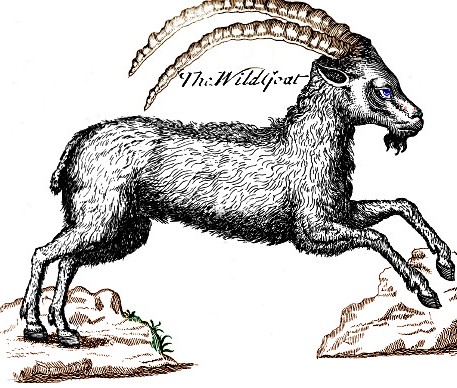
The Wild Goat, Taken from
The History of Druggs, by Pierre Pomet, 3rd ed., p. 257
"...the He or She Goat are both the tame and wild, one or other of which are Inhabitants of most parts of the World; besides which are the Rock Goat, the Oyrx, or the African Wild Goat. But I shall confine myself here to the wild and tame Goat, that feed upon barren Mountains, and waste Places, and eat almost all Sorts of green Things whatsoever; so that they live and grow fat upon what any other living Creature would be starv'd with. Their Increase is prodigious; for they sometimes bring forth four, and sometimes five at a Time; and the Ewe Kinds will have young ones before they are a Year old." (Pierre Pomet, The History of Druggs, 3rd Ed., p. 259)
Goats appear all throughout the English sea literature during the golden age of pyracy. They were found at many shore locations and could were kept shipboard so they made for good food. The goats durability resulted in several early travellers intentionally placing them on shores of convenient island like Juan Fernandez so that passing ships could stop to refresh their men and food supplies with fresh meat.1
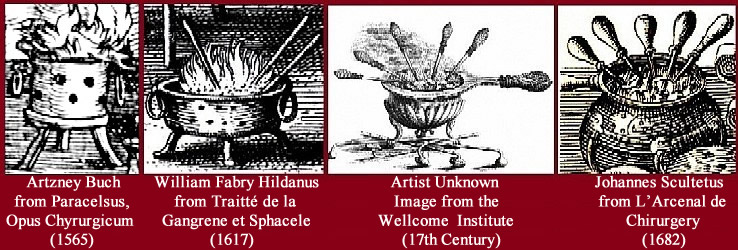 Some Illustrations of Chafing Dishes Being Used to Heat Cautery Irons |
3 John Atkins, The Navy Surgeon, 1742, p. 131
3 Philip Ashton, Ashtons Memorial Strange Adventures and Signal Deliverance, 1726, p. 1;
4 Thomas Aubrey The Sea-Surgeon or the Guinea Man’s Vadé Mecum. 1729, p. 74-89;
3 Edward Barlow, Barlow’s Journal of his Life at Sea in King’s Ships, East and West Indiamen & Other Merchantman From 1659 to 1703, p. 508;
3 Joel Baer, British Piracy in the Golden Age, Vol. 1, 2007, p. 307;
1 Elizabeth Bennion, Antique Medical Instruments, 1979, p. 156;
6 Nathaniel Boteler, Boteler's Dialogues, 1929, p. 66;
1 Stephen Bradwell, Helps For Suddain Accidents Endangering Life, 1633, p.43;
2 Kevin Brown, Poxed and Scurvied: The Story of Sickness and Health at Sea, 2011, p. 66;
2 William Clowes, Selected Writings of William Clowes, 1948, p. 84-5;
2 William Clowes,A Profitable and Necessarie Booke of Observations, for all those that are burned with the flame of Gun powder &c., 1588. p. 8;
2 Emily Cockayne, Hubbub: Filth, Noise, and Stench in England, 1600-1770, 2007, p. 95;
14 Edward Cooke, A Voyage to the South Sea and Round the World in the Years 1708 to 1711, 1969, p. 11;
4 Edward Cooke, Voyage to the South Seas, 1712, p. 146;
1 James Cooke, Mellificium Chirurgiae, 1704, p. 389;
4 Edward Coxere, Adventures by Sea of Edward Coxere, 1946, p. 107;
4 William Ambrosia Cowley, "Cowley’s Voyage Round the Globe", A collection of original voyages, William Hacke, ed., 1993, p. 2
2 Nicholas Culpeper, Pharmacopœia Londinesis, 1720, p. 32;
1 John Covel, "Extracts from the Diaries of Dr. John Covel, 1670-1679," Early Voyages and Travels in the Levant, edited by J. Theodore Bent, 1893, p. 129
7 William Dampier, Memoirs of a Buccaneer, Dampier’s New Voyage Round the World -1697-, 1968, p. 214;
7 William Dampier, A New Voyage Round the World, 1699, p. 124;
3 William Dampier. A Supplement of the Voyage Round the World, 1700, p. 153;
7 William Dampier, A New Voyage Round the World, Vol III, 1703 p. 124;
2 Jonathan Dickinson, Jonathan Dickinson's Journal or God's Protecting Providence, 1945, p. 47;
1 Johann Dietz, Master Johann Dietz, Surgeon in the Army of the Great Elector and Barber to the Royal Court, 1923, p. 409-10;
4 Pierre Dionis, A course of chirurgical operations: demonstrated in the royal garden at Paris. 2nd ed., 1733, p. 409-10;
4 George Francis Dow and John Henry Edmonds, The Pirates of the New England Coast 1630-1730, 1996, p. 123;
4 Alexandre Exquemelin, The Buccaneers of America, 1856, p. 120;
4 Clement Downing, A Compendious History of the Indian Wars, 1737, p. 43;
1 Ed Fox, "47. John Fillmore's narrative", Pirates in Their Own Words, 2014, p. 229;
9 Zachary B. Friedenberg, Medicine Under Sail, 2002, p. 35;
9 William Funnell, A Voyage Round the World, 1969, p. 226;
9 Eric J. Graham, Seawolves: Pirates & the Scots, 2005, p. 120;
9 Charles Grey, Pirates of the Eastern Seas (1618-1723), 1933, p. 120;
9 Jacques Guillemeau, The French Chirurgerie, 1597, p. 40;
2 Alexander Hamilton, British sea-captain Alexander Hamilton's A new account of the East Indies, 17th-18th century, 2002, p. 404;
5 Guliielm. Fabritius Hildanus aka William Fabry, His Experiments in Chyrurgerie, 1643, p. 3;
2 Guliielm. Fabritius Hildanus aka. William Fabry. Cista Militaris, Or, A Military Chest, Furnished Either for Sea or Land, 1676, p. 31;
1 Hippocrates, Hiipocratic Writings, Translated and Edited by Francis Adams, 1952, p. 82;
2 Bruce S. Ingram, Three Sea Journals of Stuart Times, 1936, p. 121;
3 Robert James, Pharmacopœia universalis, 1747, p. 306-7;
3 John Franklin Jameson, Privateering and Piracy in the Colonial Period - Illustrative Documents, 1923, p. 269;
1 Captain Charles Johnson, A general history of the pirates, 3rd Edition, 1724, p. 270;
1 Captain Charles Johnson, The History of the Pirates, 1829, p. 183;
1 Daniel Defoe (Captain Charles Johnson), A General History of the Pyrates, Manuel Schonhorn, ed., 1999, p. 270-1
1 John J. Keevil, Medicine and the Navy 1200-1900: Volume II – 1640-1714, 1958, p. 25;
1 John Kirkup, The Evolution of Surgical Instruments; An Illustrated History from Ancient Time to the Twentieth Century, 2005, p. 407;
3 Pere Jean-Baptiste Labat, The Memoirs of Pére Labat 1693-1705, 1970, p. 29;
3 Edward E. Leslie, Desperate Journeys, Abandoned Souls, 1988, p. 1,
2 Rory W. McCreadie, The Barber Surgeon's Mate of the 16th and 17th Century, 2002, p. 58;
1 Raymund Minderer, A Body of Military Medicines Experimented, Volume 4 of Paul Barbette's, Thesaurus Chirurgiæ, The Fourth Edition, p. 73;
2 John Moyle, Abstractum Chirurgæ Marinæ, 1686, p. 24;
1 John Moyle, Chirugius Marinus: Or, The Sea Chirurgeon, 1693, p. 2;
1 John Moyle, The Experienced Chirugion, 1703, p. 2;
6 John Moyle, Memoirs: Of many Extraordinary Cures, 1708, p. 119;
2 Domingo Navarrete, The Travels and Controversies of Friar Domingo Navarrete 1618-1686, 1962, p. 40;
3 Ambroise Paré, The Apologie and Treatise of Ambroise Paré, 1952, p.585;;
3 Ambroise Paré, The Workes of that Famous Chirurgion Ambrose Parey, 1649, p.585;
7 Pierre Pomet, The Compleate History of Druggs, 3rd Edition, 1737, p. 260;
5 John Pechey, The Compleat Herbal of Physical Plants, 1707, p. 159;
6 Matthias Gottfried Purmann, Churgia Curiosa, 1706, p. 209;
2 John Quincy, Lexicon Physico-Medicum, 1726, p. 409;
2 John Quincy, Pharmacopoeia Officinalis & Extemporanea, 1719, p. 409;
9 James Rennie, A New Supplement to the Pharmacopœpias of London, Edinburgh, Dublin and Paris, Baldwin and Cradock, 1833, p. 263;
9 George Roberts, The four years voyages of Capt. George Roberts, 1726, p. 58;
3 Francis Rogers. Three Sea Journals of Stuart Times, Bruce S. Ingram, ed., 1936, p. 230;
8 Woodes Rogers, A Cruising Voyage Round the World, 2004, p. 61;
8 Woodes Rogers, A Cruising Voyage Round the World, 1712, p. 82;
1 Hugh Ryder, New Practical Observations in Surgery Containing Divers Remarkable Cases and Cures, 1685, p. 82-3;
4 Bartholomew Sharp, "Captain Sharp's Journal of His Expedition," from William Hacke's A collection of original voyages, 1993, p. 44;
4 Captain William Snelgrave, A New Account of Some Parts of Guinea and the Slave Trade, 1971, p. 272;
4 Captain William Snelgrave, A New Account of Some Parts of Guinea and the Slave Trade, 1734, p. 272;
1 Henry Teonge, The Diary of Henry Teonge, Chaplain on Board H.M.’s Ships Assistance, Bristol, and Royal Oak, 1675-1679, 1927, p. 190
1 Henry Teonge, The Diary of Henry Teonge, Chaplain on Board H.M.’s Ships Assistance, Bristol, and Royal Oak, 1675-1679, 1825, p. 200;
4 Nathaniel Uring, A history of the voyages and travels of Capt. Nathaniel Uring, 1928, p. 242;
4 Lionel Wafer, A New Voyage and Description of the Isthmus of America, 1903, p. 103;
;4 Vice-Admiral Sir James Watt, "The burns of seafarers under oars, sail and steam", Injury: the British Journal of Accident Surgery, Vol. 12, p
;4 Vice-Admiral Sir James Watt, "Some forgotten contributions of naval surgeons", Journal of the Royal Society of Medicine, Vol. 78, September 1985, p.
2 Guy Williams, The Age of Agony, 1986, p. 81;
1 Richard Wiseman, Of Wounds, Severall Chirurgicall Treatises, 1686, p. 454;
1 Richard Wiseman, Eight Chirurgicall Treatises, 3rd Edition, 1696, p. 430;
3 John Woodall, the surgions mate, 1617, p. 202;
3 John Woodall, Woodalls Viaticum, 1628, p. 116;
1 James Yonge, Currus Triumpalis, é Terebinthô.,1679, p. 110-1
4 James Yonge, The Journal of James Yonge [1647-1721] Plymouth Surgeon, 1965, p. 41-2;
Goats in Medicine: 1 2 3 4 <<First

Main Page • Tools & Procedures • Miscellanea • About the Author • Facebook Page
All original content copyright M. Kehoe • 2003-